


It keeps all those devices running smoothly on Wi-Fi.
Recycling

You can feel good about your purchases while helping to protect the environment.

If you have a computer desktop screen covered with icons, here's some advice for cleaning it up.

At Best Buy, we want our customers to be excited about the latest tech. We also have a story to tell about the packaging those products come in. We’re excited to share that we’ve made some small but impactful changes to the packaging of our private label products so that it’s better for the environment.
Our Modal brand cellphone case packaging is now made 100 percent from bioplastics, a material that breaks down over time.
If a product is made from bioplastics, that means it has the same properties as plastic, but is made from plants and is biodegradable.

Climate change is a global issue that will only be solved through collective efforts. Best Buy is focused on reducing our own carbon impact, and helping our customers use less energy as well. Here are some of the ways we contribute to this effort:
- We are on track to exceed our science-based goal of reducing our carbon emissions 45 percent by 2020 (over a 2009 baseline).
- We optimize our store energy usage by automating the lighting, heating and air conditioning.
- We transitioned our Geek Squad car fleet to the hybrid Toyota Prius c, reducing fuel usage.
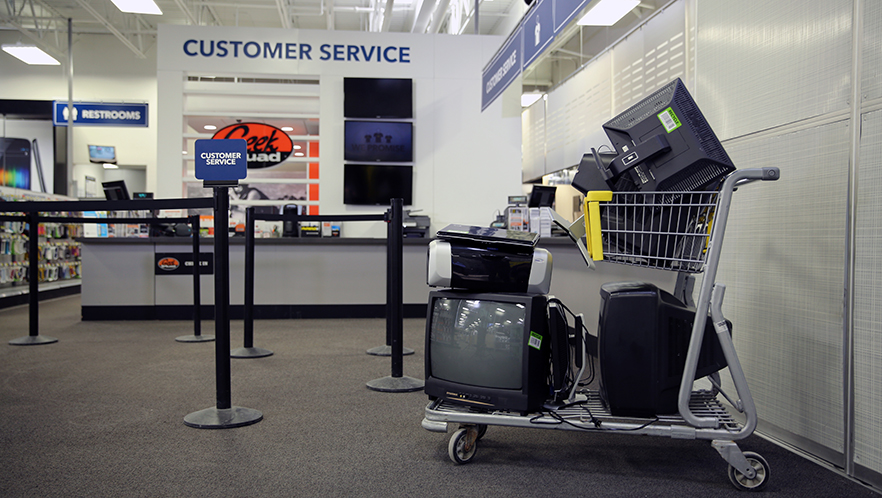
Earth Month might be over, but at Best Buy, we think about our environmental footprint every day of the year. In addition, we help our customers live more sustainably, including offering a convenient place to responsibly recycle unwanted electronics.
Before you bring in your items for recycling, check to see if your tech still has value with our Trade-In Calculator. Depending on the item, Best Buy might give you a gift card for your used tech, which will then be re-sold giving the product a new life.

Positively impacting our world is a year-round focus for the company.

Whether your office is at home or in a shared space, there are easy changes you can make to make it more sustainable.

At Best Buy, we are continuously looking for opportunities to reduce energy usage and carbon emissions, not just in our stores and distribution centers, but at our corporate office too. As proof of that, for the 11th year, we are proud to announce that the Best Buy corporate office has earned the U.S. Environmental Protection Agency’s (EPA’s) ENERGY STAR certification.
Commercial buildings that earn EPA’s ENERGY STAR certification use an average of 35 percent less energy than typical buildings and also release 35 percent less carbon dioxide into the atmosphere.

Those fancy thin screens with superb pictures are super fragile and need to be handled with TLC. Here are some tips for getting a new television home and set up safely.

The award commends superior corporate efforts to divert electronics from landfills by working with third-party certified recyclers, as well as being transparent about recycling data and performance.

If you haven’t finished your holiday shopping just yet, here are a few gift ideas that you can feel good about giving. Each of these cool sustainable tech items also help to protect the environment.